
Nutrition Tips
How to Calculate Calories for an Entire Recipe: A Simple Step-by-Step Guide
Learn how to measure recipe ingredients, calculate total calories, divide homemade dishes into servings, and track portions more accurately.
NourishCal · Oct 25, 2026 · 9 min read
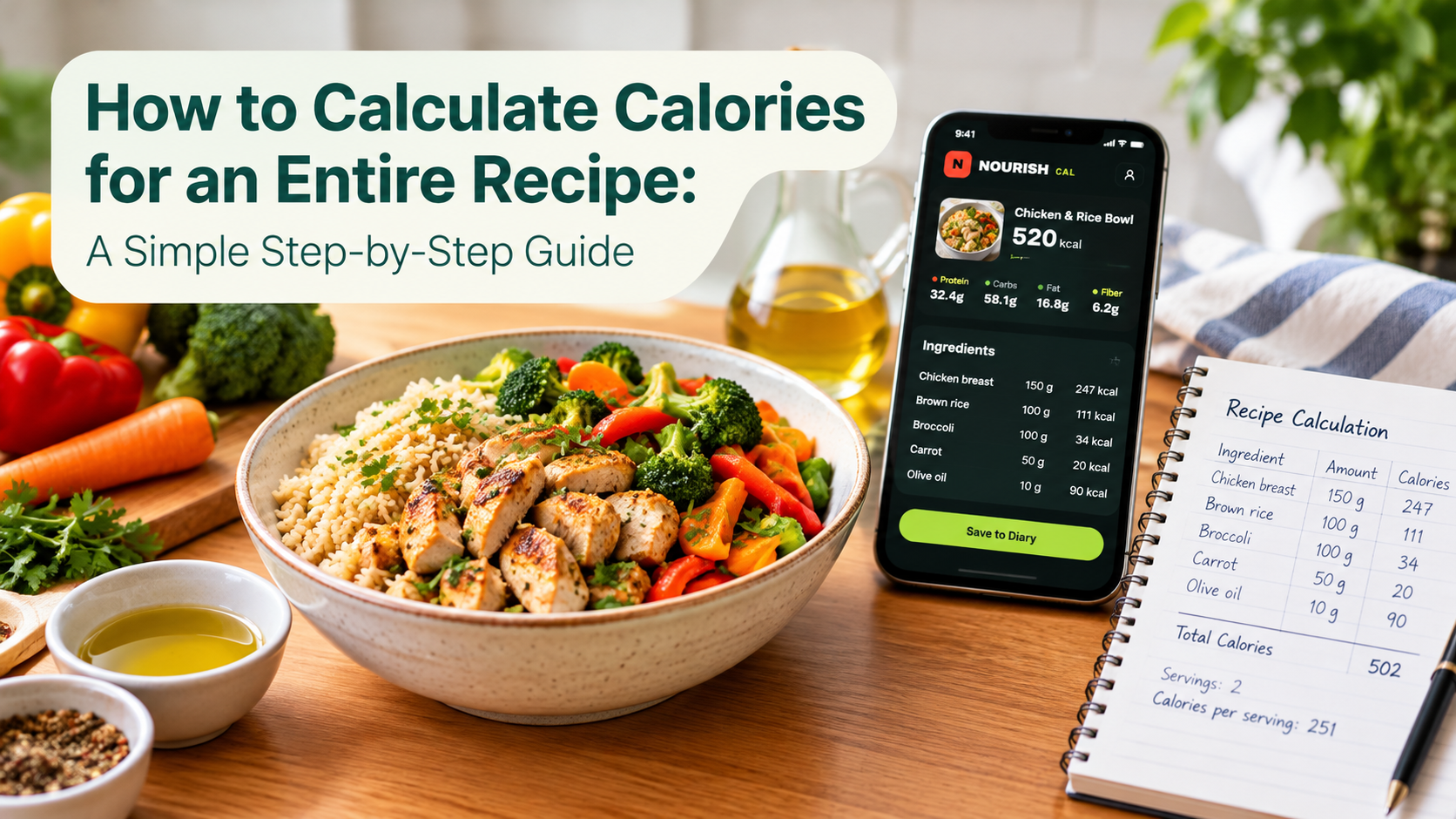
Calculating calories for a homemade recipe can seem complicated, especially when a dish contains several ingredients. But once you know how to measure each ingredient and add its calories together, tracking homemade meals becomes much easier.
Whether you are preparing vegetable soup, chicken curry, pasta, fried rice, or a family-sized casserole, you can estimate the calories in the entire recipe and work out how much is in each serving.
In this guide, you will learn how to measure ingredients, calculate total recipe calories, divide a dish into portions, and avoid common mistakes.
Why Calculate Calories for the Whole Recipe?
Many homemade dishes contain multiple ingredients, and the final meal may be difficult to track by looking at it alone.
For example, a vegetable curry might contain vegetables, oil, onions, tomatoes, and spices. Each ingredient contributes a different amount of energy.
Calculating the entire recipe helps you:
- Estimate calories in homemade meals more consistently.
- Understand how cooking oil, sauces, and other additions affect total calories.
- Calculate calories per serving instead of guessing.
- Track meals that contain several mixed ingredients.
- Compare portion sizes more accurately over time.
Step 1: List Every Ingredient
Start by writing down everything that goes into your recipe. Include ingredients that are easy to overlook, such as cooking oil, butter, sugar, coconut milk, dressings, and sauces.
For example, a simple homemade chicken and vegetable dish might contain:
- Chicken
- Rice
- Mixed vegetables
- Cooking oil
- Onion
- Tomato
- Spices and seasonings
You do not need to calculate everything mentally. A written list, spreadsheet, or calorie-tracking app can help you keep track of each ingredient.
Step 2: Measure Ingredients Before Cooking
A digital kitchen scale is one of the most useful tools for calculating recipe calories. Measuring ingredients in grams generally provides a more consistent estimate than using handfuls, bowls, or spoons.
Whenever practical, weigh ingredients before cooking and record whether the weight is raw, dry, drained, or cooked.
For example:
| Ingredient | Amount to record |
|---|---|
| Dry rice | 150 g |
| Raw chicken breast | 300 g |
| Mixed vegetables | 200 g |
| Cooking oil | 10 g |
These quantities are an example for demonstrating the calculation, not a prescribed meal.
Important: Match the weight to the food entry you use. If you weigh dry rice, use the calorie information for dry rice. Do not use a cooked-rice entry for that same dry weight.
Step 3: Find the Calories in Each Ingredient
Check the nutrition label on packaged foods or use a reliable food database. Record the calories for the exact amount you used.
If the database gives calories per 100 grams, use this formula:
Ingredient calories = (ingredient weight in grams ÷ 100) × calories per 100 g
Suppose a food contains 130 calories per 100 grams and you use 200 grams:
(200 ÷ 100) × 130 = 260 calories.
You can use the same formula for rice, vegetables, meat, and other ingredients, provided the calorie value matches the form of the food you measured.
For packaged products, use the label when possible. For unlabelled ingredients, choose a reputable nutrition database and use the closest matching food entry.
Step 4: Add the Calories Together
Once you have calculated the calories for each ingredient, add them to find the estimated total for the recipe.
Here is an illustrative calculation:
| Ingredient | Amount | Example calories |
|---|---|---|
| Dry rice | 150 g | 540 |
| Raw chicken breast | 300 g | 360 |
| Mixed vegetables | 200 g | 60 |
| Cooking oil | 10 g | 90 |
| Onion and tomato | 150 g | 45 |
| Total | 1,095 calories |
These are rounded illustrative values, not verified nutrition values for a specific recipe. Actual calories depend on the ingredients, their preparation, and the nutrition data used.
Notice that cooking oil contributes calories even though it adds relatively little weight. Measuring it instead of pouring freely can make your estimate more accurate.
Step 5: Calculate Calories Per Serving
After finding the total calories, decide how many servings the recipe makes.
Use this formula:
Calories per serving = total recipe calories ÷ number of servings
Using the illustrative total of 1,095 calories:
- 2 equal servings: approximately 548 calories each.
- 3 equal servings: 365 calories each.
- 4 equal servings: approximately 274 calories each.
These figures assume the food is divided evenly and that the entire calculated recipe is consumed.
If you serve different-sized portions, the calories will differ. Dividing by the number of people is only an estimate when portions are not equal.
Step 6: Get More Accurate With Cooked Recipe Weight
For dishes that are difficult to divide evenly, weighing the finished recipe can help.
Once cooking is complete:
- Weigh the empty cooking pot or container before adding food, or record its weight separately.
- Weigh the pot with the finished food.
- Subtract the empty pot's weight to find the cooked food's net weight.
- Divide the total recipe calories by the cooked food's net weight.
For example, suppose a finished dish contains an estimated 1,200 calories and weighs 800 grams.
1,200 ÷ 800 = 1.5 calories per gram.
A 200-gram portion would therefore contain approximately 300 calories.
This method is especially useful for curries, soups, stews, sauces, and other mixed dishes. The calculation assumes the food is reasonably evenly mixed.
Step 7: Account for Cooking Changes
Cooking can change the weight of food without changing its calories by the same proportion.
Rice and pasta absorb water as they cook, while meat and vegetables may lose water. As a result, cooked food can have a different calorie concentration per gram than its raw or dry form.
Keep these points in mind:
- Water: Usually adds weight without adding calories.
- Oil: Adds calories; measure the amount used when possible.
- Drained liquids: Some calories may leave with discarded cooking liquid or fat.
- Leftovers: If you do not eat the whole recipe, track the amount actually consumed.
- Shared dishes: Use the finished weight to calculate portions more consistently.
For home cooking, these methods provide estimates rather than laboratory-level measurements.
Common Mistakes to Avoid
1. Forgetting cooking oil
Oil, butter, ghee, and other fats can contribute substantial calories. Include the amount added to the recipe.
2. Mixing raw and cooked food entries
A weight of dry rice should be matched with dry-rice nutrition data. A weight of cooked rice should be matched with cooked-rice data.
3. Guessing ingredient quantities
A small difference in oil, nuts, cheese, or other energy-dense ingredients can affect the final total. Weigh these ingredients when practical.
4. Assuming every serving is identical
If one person takes a larger portion, that person consumes a different share of the recipe's calories. Weigh portions when you need a closer estimate.
5. Treating estimates as exact values
Nutrition labels, food databases, ingredient brands, and preparation methods can all introduce variation. Consistent measurements are more useful than pretending every number is perfectly precise.
How NourishCal Can Help
NourishCal can help simplify food logging by letting you record meals and use AI-assisted food scanning to estimate nutritional information.
For a homemade recipe with several ingredients, measuring the ingredients and calculating the total first can provide a useful reference. You can then use the finished recipe's calories and serving weight to estimate the portion you eat.
AI food estimates can be helpful when you do not know the exact ingredients, but they may not identify hidden oil, sauces, or precise portion weights. For the most consistent results, combine food logging with ingredient measurements whenever possible.
Frequently Asked Questions
How do I calculate calories for a homemade recipe?
Find the calories for each ingredient in the quantity you use, add them together, and divide the total by the number of equal servings. For uneven portions, use the finished recipe's weight to estimate calories per gram.
Should I weigh ingredients before or after cooking?
Use the weight that matches your nutrition data. Dry rice should be matched with dry-rice data, while cooked rice should be matched with cooked-rice data. For a mixed dish, you can calculate calories from the ingredients and then weigh the finished recipe to determine portion sizes.
Do I need to count spices?
Small quantities of many dried spices contribute relatively few calories, but larger amounts of calorie-containing ingredients such as sugar, coconut milk, nuts, and oil should be included. For consistency, record all meaningful ingredients.
How do I calculate calories if I eat only part of a recipe?
If the dish is mixed evenly, calculate its total calories per gram and multiply that value by the weight of your portion. If the ingredients are unevenly distributed, such as meat pieces in a curry, this method is less precise.
Is calculating recipe calories completely accurate?
No. It is an estimate. Differences in ingredient brands, natural food variation, cooking losses, and measurement accuracy can affect the result. Weighing ingredients and using matching nutrition data can make the estimate more consistent.
Final Thoughts
You do not need complicated equipment to calculate calories for a homemade recipe. Start by listing your ingredients, weighing them, matching each weight to the correct nutrition information, and adding the calories together.
Then divide the total by the number of servings or weigh the finished dish to estimate calories per gram. With a little practice, this method can make homemade meal tracking more consistent and easier to maintain.
Nutrition information in this article is for general educational purposes. Individual food values vary by ingredients and preparation methods. If you need nutrition advice for a medical condition, consult a qualified healthcare professional or registered dietitian.
#Recipe Calories#Calorie Tracking#Ingredient Measurement#Portion Sizes#Meal Planning#Nutrition Tips#Homemade Meals