
Nutrition and Healthy Eating
How Many Calories Should You Eat Per Day? A Simple Guide for Europeans
Discover how many calories you need each day based on your age, activity level, and goals, with practical tips and European food examples to help you track your daily intake.
NourishCal Team · Oct 24, 2026 · 13 min read
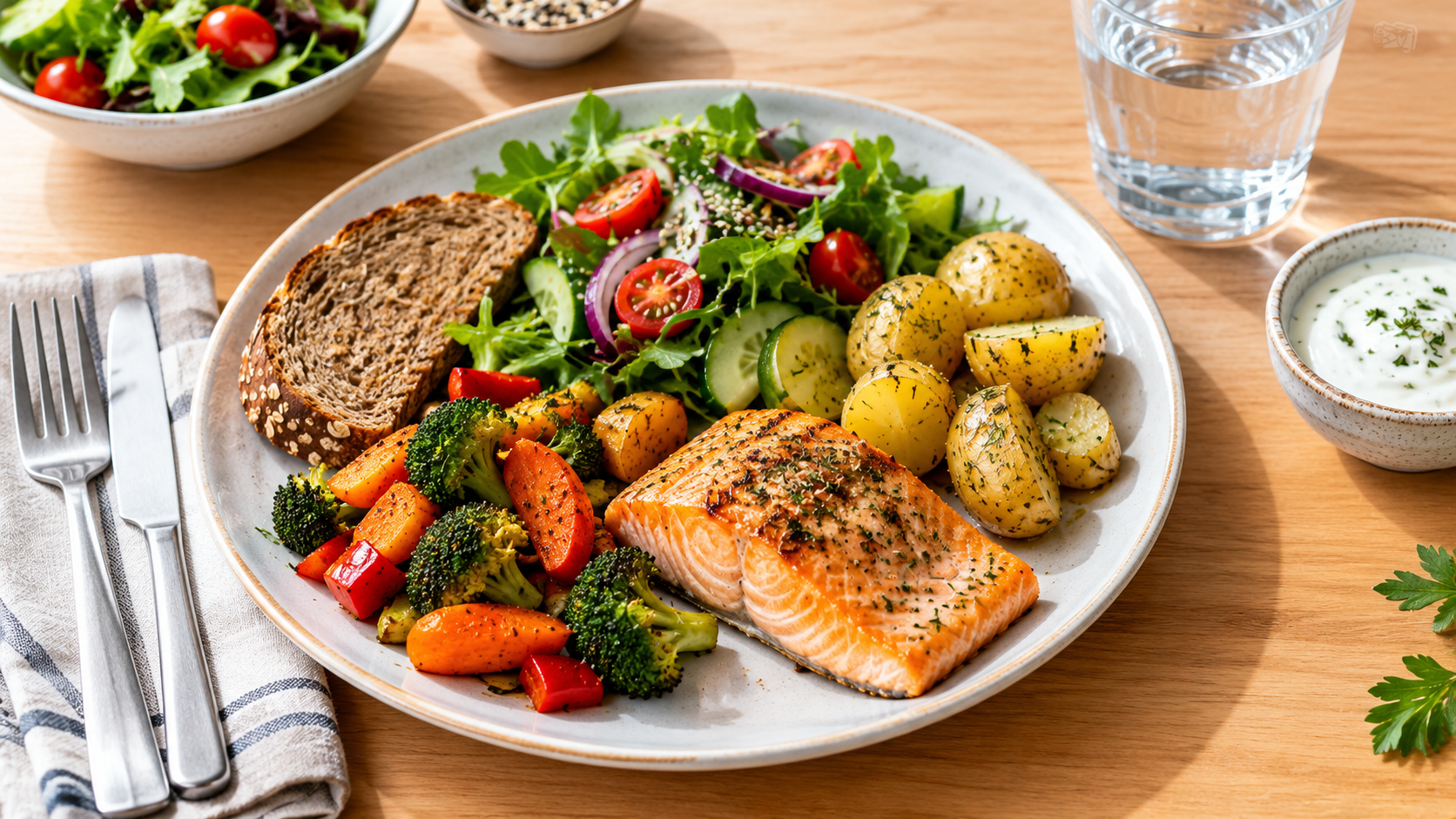
Have you ever wondered whether you are eating too many calories, too few, or just the right amount for your body?
Understanding your daily calorie needs can help you make informed decisions about your diet, whether you want to maintain your current weight, lose weight, or gain muscle.
However, there is no single calorie target that works for everyone. Your needs depend on several factors, including your age, height, weight, biological sex, physical activity, and personal goals.
In this guide, we explain how many calories adults generally need each day, what can change your requirements, and how to estimate your intake using familiar European foods.
How Many Calories Do Adults Need Per Day?
As a broad reference, UK public health guidance uses the following average daily amounts for adults:
| Adult group | Approximate daily calories |
|---|---|
| Women | 2,000 kcal |
| Men | 2,500 kcal |
These figures are general reference values, not personalised prescriptions. Your actual needs may be higher or lower depending on your body size, age, activity level, and other individual factors. Source: NHS
For example, someone who spends most of the day sitting may need less energy than someone who cycles to work, walks frequently, or performs physically demanding work.
Similarly, two adults of the same age and sex can have different calorie requirements because their height, weight, body composition, and activity levels differ.
The key takeaway: Use average calorie figures as a starting point, not as a strict daily limit.
What Factors Affect Your Daily Calorie Needs?
Your body uses energy throughout the day, even when you are resting. The amount you need depends on a combination of factors.
1. Age
Energy needs can change as you get older. Changes in body composition, activity, and other physiological factors can influence how many calories you use each day.
Children and teenagers have different nutritional needs from adults, so adult calorie guidance should not be applied to them.
2. Height and Weight
Larger bodies generally require more energy to maintain their basic functions and support movement.
This means a taller or heavier adult may need more calories than a smaller adult with a similar activity level. However, body composition also matters, so height and weight alone cannot determine an exact target.
3. Physical Activity
Your daily movement can make a significant difference.
Consider these broad activity patterns:
- Mostly sedentary: You spend much of the day sitting and do little structured exercise.
- Lightly active: You walk regularly and do some light exercise.
- Moderately active: You exercise several times a week or move frequently during the day.
- Very active: You do demanding physical work, train intensively, or participate in high-volume sports.
Someone who cycles daily and trains regularly may need considerably more energy than someone who works at a desk and rarely exercises.
4. Your Goal
Your goal also affects the amount you may choose to eat.
- Weight maintenance: Aim to consume approximately the energy your body uses.
- Weight loss: A suitable, sustainable calorie deficit may help you lose weight over time.
- Weight gain: A moderate calorie surplus may support gradual weight gain, depending on your circumstances.
- Muscle development: You need sufficient energy, protein, and appropriate resistance training.
A calorie target should support your health and lifestyle rather than encourage unnecessary restriction.
How Many Calories Should You Eat to Lose Weight?
Weight loss generally occurs when you consistently consume less energy than your body uses. This is known as a calorie deficit.
The appropriate deficit varies between individuals. A target that is reasonable for one person may be unsuitable for another.
For instance, someone whose estimated maintenance requirement is 2,400 kcal per day would approach weight loss differently from someone whose maintenance requirement is 1,800 kcal per day.
UK NHS guidance discusses reducing intake by around 600 kcal per day as a general approach for some adults seeking weight loss. This is not appropriate for everyone and should not be treated as a universal rule. Source: NHS
When planning weight loss:
- Choose a realistic approach you can maintain.
- Eat a varied diet with adequate protein, fibre, and essential nutrients.
- Include regular physical activity that suits your abilities.
- Monitor your progress over time rather than reacting to daily weight changes.
- Avoid extreme calorie restriction without appropriate medical supervision.
If you are already underweight, have a history of disordered eating, or have a medical condition that affects nutrition, seek professional advice before intentionally reducing your intake.
How Many Calories Should You Eat to Maintain Your Weight?
Weight maintenance means providing your body with approximately the amount of energy it uses over time.
Your weight does not need to remain exactly the same every day. Water retention, digestion, hormonal changes, and other factors can cause normal short-term fluctuations.
If your goal is maintenance, begin with a reasonable estimate of your daily needs. Observe your eating habits and longer-term weight trend, and adjust gradually if necessary.
For example, an adult who maintains their weight while eating approximately 2,200 kcal per day may have a different requirement from someone who maintains their weight at 1,900 kcal per day.
Neither figure is automatically better. The appropriate amount depends on the individual.
How Many Calories Should You Eat to Gain Weight?
People who want to gain weight may need to consume more energy than their bodies use.
A gradual increase in food intake can be a practical starting point for some adults. Combining sufficient energy and protein with resistance training may support muscle development.
Focus on nutritious, energy-dense foods such as:
- Nuts and seeds.
- Olive oil.
- Wholegrain bread.
- Oats.
- Eggs.
- Greek yoghurt.
- Beans and lentils.
- Fish, poultry, tofu, or other protein-rich foods.
If you are unintentionally losing weight or struggling to gain weight, speak with a healthcare professional to investigate possible causes and determine an appropriate plan.
What Does a Day of Eating 2,000 Calories Look Like?
Calories can come from many different foods. The following example illustrates how an approximately 2,000-kcal day might be distributed across familiar European meals.
The amounts are illustrative estimates, not exact nutritional values.
| Meal | Example foods | Approximate calories |
|---|---|---|
| Breakfast | Oats with milk, berries, and a small portion of nuts | 400 kcal |
| Lunch | Wholegrain bread, chicken, salad, and olive-oil dressing | 500 kcal |
| Snack | Apple and Greek yoghurt | 200 kcal |
| Dinner | Baked salmon, potatoes, and roasted vegetables | 650 kcal |
| Evening snack | Wholegrain toast with peanut butter | 250 kcal |
| Daily total | 2,000 kcal |
Actual calories will vary with portion sizes, product brands, recipes, and cooking methods.
This example is not a recommended target for every adult. Someone who needs more energy may require larger portions or additional meals, while another person may need a different overall intake.
The aim is to understand how meals contribute to your daily total without treating a sample menu as a rigid plan.
Calories in Popular European Foods
Knowing the approximate energy content of everyday foods can help you make more informed choices.
The following values are general estimates for typical portions.
| Food | Example serving | Approximate calories |
|---|---|---|
| Oatmeal prepared with water | 40 g dry oats | 150 kcal |
| Wholegrain bread | 1 medium slice | 80–110 kcal |
| Boiled potatoes | 200 g | 150–180 kcal |
| Cooked pasta | 150 g | 220–250 kcal |
| Cooked white rice | 150 g | 190–210 kcal |
| Plain Greek yoghurt | 170 g | 100–180 kcal |
| Apple | 1 medium | 80–100 kcal |
| Egg | 1 large | 70–90 kcal |
| Salmon | 150 g cooked | 280–330 kcal |
| Olive oil | 1 tablespoon | 120 kcal |
These estimates vary by product, preparation, and portion size. For packaged foods, check the nutrition label. For homemade dishes, consider the ingredients and the amount you actually eat.
Also remember that calorie content alone does not determine whether a food is nutritious. Fibre, protein, vitamins, minerals, and the overall balance of your diet matter too.
How to Calculate Your Personal Daily Calorie Needs
You can estimate your daily calorie needs using a calculator based on your personal details.
A common approach involves two calculations:
- Basal metabolic rate (BMR): An estimate of the energy your body uses at rest.
- Total daily energy expenditure (TDEE): An estimate of your total daily energy use, including movement and exercise.
One commonly used method is the Mifflin–St Jeor equation.
For adults, the equations are:
Men:
BMR = (10 × weight in kg) + (6.25 × height in cm) − (5 × age in years) + 5
Women:
BMR = (10 × weight in kg) + (6.25 × height in cm) − (5 × age in years) − 161
These equations provide estimates, not direct measurements of metabolism. They may not accurately represent every individual.
To estimate total daily energy expenditure, the BMR estimate is multiplied by an activity factor. Common illustrative factors range from about 1.2 for a sedentary lifestyle to around 1.7–1.9 for some highly active lifestyles, although the appropriate factor depends on the person.
The result can provide a starting estimate for weight maintenance. Your real needs may differ, so use the result as a guide rather than an exact number.
How to Track Your Daily Calories More Easily
Once you have a rough idea of your daily needs, tracking what you eat can help you understand your usual eating habits.
Here are five practical steps.
1. Record Your Meals
Keep a record of breakfast, lunch, dinner, snacks, and drinks. Include extras such as cooking oil, sauces, spreads, and sugar when practical.
2. Pay Attention to Portions
A small bowl of pasta and a large restaurant serving can have very different calorie totals.
Use food labels, measuring cups, a kitchen scale, or consistent household portions to improve your estimates.
3. Check Nutrition Labels
In many European countries, packaged food labels list energy in both kilojoules (kJ) and kilocalories (kcal), often per 100 g or 100 ml and sometimes per serving.
Make sure you compare the serving you actually eat with the portion stated on the label.
4. Track More Than Calories
Depending on your goals, it may also help to monitor protein, carbohydrates, fats, and fibre.
Choose a balanced range of foods rather than focusing solely on reaching a calorie number.
5. Use a Food-Tracking App
A food diary can make it easier to record meals and review your intake over time.
NourishCal helps you log meals by taking or uploading a food photo. Its AI identifies likely foods and estimates portions, after which you can review and adjust the results before adding a meal to your diary.
This can be useful for meals containing several ingredients, but a photo cannot reliably reveal exact food weights, hidden ingredients, or the amount of oil used. Treat AI-generated values as estimates rather than exact measurements.
Ready to make food logging easier? Visit NourishCal to try photo-based meal tracking.
Common Mistakes to Avoid When Counting Calories
Even a useful tracking routine can become less accurate if you overlook a few details.
Ignoring cooking ingredients: Olive oil, butter, cream, dressings, and sauces can add calories to a meal.
Using generic portion sizes: Your actual serving may be considerably larger or smaller than a database's default portion.
Assuming every day must be identical: Your appetite and energy needs can vary. Focus on sustainable habits over time.
Trusting estimates without checking them: Food databases and AI recognition tools can contain errors. Review uncertain entries and use reliable labels or recipes when available.
Focusing only on calories: A balanced diet also needs adequate protein, fibre, vitamins, minerals, and other essential nutrients.
Setting an unnecessarily low target: Eating too little can make it harder to meet your nutritional needs and maintain a healthy routine.
Frequently Asked Questions
1. Is 2,000 calories a day enough for everyone?
No. Around 2,000 kcal is a common reference figure for adult women in UK guidance, but individual requirements vary. Some adults need more energy, while others need less.
2. Do men always need more calories than women?
Not always. Average reference values differ, but individual requirements depend on body size, age, activity, body composition, and other factors. A person's actual needs may differ substantially from a population average.
3. Should I eat fewer calories if I work at a desk?
A sedentary lifestyle generally means lower energy expenditure than a highly active lifestyle. However, you should estimate your individual needs rather than automatically choosing a very low calorie target.
4. Are kilocalories and calories the same thing on food labels?
In everyday nutrition, the word “calories” usually refers to kilocalories (kcal). One kilocalorie equals 1,000 small scientific calories. European labels may also show energy in kilojoules: 1 kcal is approximately 4.184 kJ.
5. How can I calculate calories without weighing every meal?
You can use package labels, standard serving sizes, recipes, and a food diary. Weighing food can improve accuracy, particularly when you are learning portion sizes, but it is not essential for everyone.
6. Can a food-photo app accurately calculate my calories?
Food-photo apps can identify likely foods and estimate portion sizes, but they cannot guarantee exact calorie values. Ingredients hidden from view, cooking methods, and portion-size errors can affect the result. Always review the estimate.
7. Is calorie counting necessary for a healthy diet?
No. Some people find it helpful, while others prefer to focus on balanced meals, hunger and fullness cues, and consistent habits. Choose an approach that supports your health and wellbeing.
Final Thoughts
The number of calories you need each day depends on your body, activity level, and goals. The familiar figures of around 2,000 kcal for women and 2,500 kcal for men are useful starting points, but they are not universal targets.
Begin with a reasonable estimate, eat a varied and balanced diet, and pay attention to your longer-term patterns rather than expecting every day to be perfect.
If you want to understand your eating habits more clearly, a food diary can help you see what you eat and identify patterns worth reviewing.
Make meal tracking simpler with NourishCal. Take a photo, review your food estimate, and build a clearer picture of your daily intake.
Health Disclaimer
This article is for general educational purposes and does not replace individual medical or nutritional advice. Daily calorie needs vary, and the examples in this article are estimates rather than personalised recommendations. People who are pregnant or breastfeeding, under 18, managing a medical condition, recovering from an eating disorder, or experiencing unexplained weight changes should seek guidance from an appropriate healthcare professional before making significant dietary changes.
References
- NHS — Understanding calories
- NHS — Calories and weight loss
- European Food Safety Authority — Your nutrition needs
- European Food Safety Authority — Dietary reference values
#daily calorie needs#calorie intake#calorie calculator#European nutrition#weight management#healthy eating#calorie tracking