
& Calorie Tracking
How to Track Calories in Indian Food: A Beginner's Guide
Learn simple ways to estimate calories, understand portion sizes, account for cooking oil, and track the nutrition in your everyday Indian meals.
NourishCal · Oct 22, 2026 · 10 min read
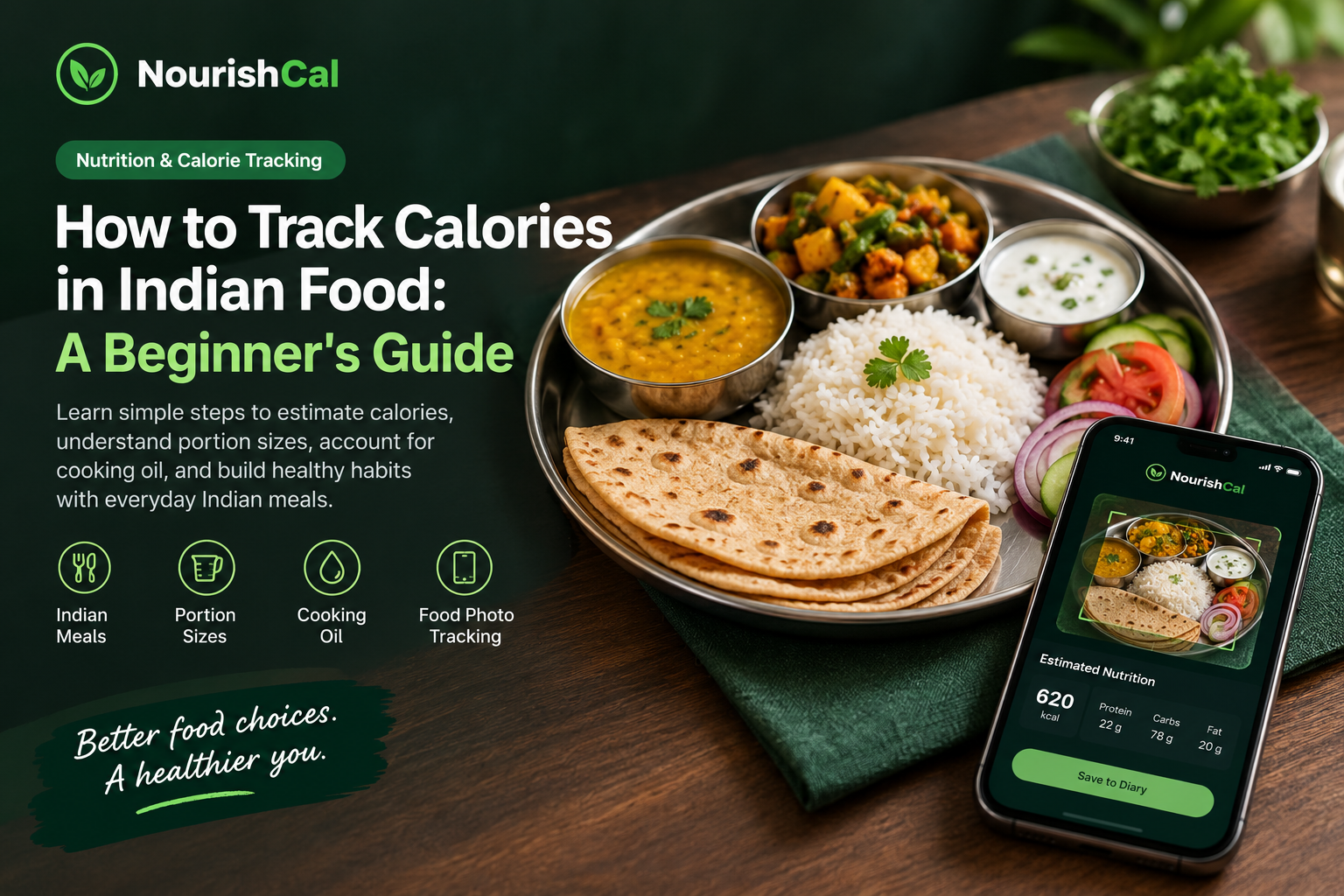
Tracking calories can feel confusing when your everyday meals include roti, rice, dal, sabzi, dosa, idli, or homemade curry. Unlike packaged foods, home-cooked meals rarely come with nutrition labels. Ingredients and portion sizes also vary from one kitchen to another.
The good news? You don't need to weigh every grain of rice or stop eating your favorite Indian foods to understand your eating habits. With a few simple techniques, you can start estimating your daily calorie intake and make more informed food choices.
In this beginner-friendly guide, we'll explain how to track calories in Indian food, what affects the calorie content of common meals, and how a food-tracking app like NourishCal can help simplify the process.
What Are Calories, and Why Do They Matter?
Calories are a measure of energy. Your body uses energy to breathe, digest food, maintain body temperature, move, and perform everyday activities.
The energy you get from food helps your body function. Your individual calorie needs depend on factors such as age, body size, activity level, and health goals.
People often track calories to understand their eating habits, manage their weight, support exercise, or make sure they're eating enough. However, calories are only one part of nutrition. Protein, carbohydrates, fats, fiber, vitamins, minerals, and the overall quality of your diet also matter.
The goal isn't to eat as little as possible. It's to understand what you're eating and find an approach that works for your lifestyle.
Why Tracking Calories in Indian Food Can Be Difficult
Indian meals are diverse, and the same dish can have very different calorie totals depending on how it's prepared.
Here are four common challenges.
1. Homemade recipes vary
One household might prepare dal with a small amount of oil, while another uses a generous tadka with oil or ghee. Both meals may be called dal, but their calorie contents can differ.
Similarly, a plain roti and a roti brushed with ghee are not nutritionally identical.
2. Portion sizes are easy to underestimate
A small bowl of rice and a large serving of rice can look similar when served in different dishes. The amount of food on your plate matters, so portion awareness is an important part of calorie tracking.
3. Cooking oil adds energy
Oil, butter, and ghee contribute calories even when they aren't visible in the finished dish. Fried foods, rich gravies, and restaurant meals can contain more added fat than you might expect.
4. Recipes contain multiple ingredients
A vegetable curry may include vegetables, onions, tomatoes, oil, coconut, cream, or other ingredients. Estimating the whole dish requires considering more than its main ingredient.
You don't need perfect accuracy from day one. Consistent, reasonable estimates are a useful starting point.
How to Track Calories in Indian Food: 6 Simple Steps
Step 1: Start with the foods you eat regularly
Begin with your usual meals rather than trying to track every possible food.
For example, list the foods you commonly eat for breakfast, lunch, dinner, and snacks:
- Breakfast: poha, upma, idli, dosa, or eggs
- Lunch: roti or rice, dal, sabzi, and curd
- Snacks: fruit, nuts, biscuits, or tea with milk and sugar
- Dinner: roti, vegetables, paneer, chicken, or another protein source
This gives you a practical starting point and helps you recognize your eating patterns.
Step 2: Pay attention to portion sizes
A calorie estimate is only as useful as the portion estimate behind it.
You can use measuring cups, a kitchen scale, or familiar serving sizes to make your estimates more consistent. If you don't have measuring tools, start by recording the number of rotis, bowls of rice, or servings of dal you eat.
For packaged foods, use the nutrition label and check whether the information refers to the whole package or a single serving.
For homemade meals, remember that a small bowl in one home may hold a different quantity from a small bowl in another.
Step 3: Include oil, ghee, sauces, and extras
It's easy to remember the main food while forgetting the ingredients used to prepare it.
When possible, account for:
- Oil or ghee used in cooking
- Butter added to roti or paratha
- Sugar in tea or coffee
- Chutneys, dressings, and sauces
- Cream, coconut milk, or other rich ingredients
For a shared recipe, estimating the total ingredients and dividing the result by the number of servings can be more reliable than guessing each plate separately.
Step 4: Use consistent food entries
Food databases may contain several entries for the same food. Cooked rice, uncooked rice, plain roti, and ghee-brushed roti should not automatically be treated as interchangeable.
Choose the entry that most closely matches what you ate. Pay attention to whether the listed quantity is measured by weight, volume, or individual item.
Also distinguish between raw and cooked weights. Rice and lentils absorb water during cooking, changing their weight without adding calories from water itself.
Step 5: Record meals as you eat them
Recording meals soon after eating can make tracking easier than trying to remember everything at the end of the day.
A simple daily log might include:
- Breakfast and drinks
- Lunch and any sides
- Evening snacks
- Dinner
- Any additional food or beverages
Don't worry if you miss an entry occasionally. Record what you remember and continue with your next meal rather than abandoning the habit.
Step 6: Review patterns instead of chasing perfection
After several days, review your log. Are you regularly skipping meals and feeling hungry later? Are snacks or sugary drinks missing from your estimates? Are your meals providing enough protein and fiber?
Use these observations to make gradual changes where appropriate. A food diary is a tool for understanding your habits, not a test you have to pass.
Calories in Common Indian Foods
The following are broad illustrative estimates for common foods. Actual values vary with size, recipe, ingredients, and preparation. These figures are not laboratory measurements or exact values for every serving.
| Food | Illustrative calorie estimate |
|---|---|
| 1 medium plain roti | 80–120 kcal |
| 1 cup cooked white rice | 180–250 kcal |
| 1 cup dal | 120–250 kcal |
| 1 cup vegetable sabzi | 100–250 kcal |
| 1 medium idli | 35–70 kcal |
| 1 medium plain dosa | 120–200 kcal |
| 1 boiled egg | 65–80 kcal |
| 1 medium banana | 90–120 kcal |
| 100 g plain curd | 55–100 kcal |
These examples can help you get started, but don't use them as fixed values for every meal.
For a more meaningful estimate, consider the serving size and preparation method. A large roti may contain more calories than a small one, and a rich restaurant curry may differ considerably from a lighter homemade version.
Can You Track Calories from a Food Photo?
Yes, food-photo analysis can help estimate the calories and nutrients in a meal.
Instead of searching for every ingredient manually, you can photograph your meal using a food-tracking app. An AI-powered tool can identify likely foods and estimate their nutritional values.
However, a photo has limitations. It may not reveal the exact weight of the food, how much oil was used, hidden ingredients, or the recipe behind a dish. Two meals that look similar can have different calorie totals.
For better results:
- Take a clear photo showing the entire meal.
- Keep the main food items visible rather than hiding them beneath one another.
- Review the detected foods and correct any mistakes.
- Adjust portion sizes when the app allows it.
- Add important details about cooking methods or ingredients when possible.
Treat photo-based results as estimates, not exact measurements. If precision matters, use ingredient quantities, food labels, or a kitchen scale to improve the information you enter.
How nourishcal.online Can Help You Track Your Meals
nourishcal.online is designed to make food tracking more convenient. Its photo-based food analysis can help you identify foods and estimate their nutritional information without having to search manually for every item.
A simple workflow is:
- Open NourishCal and use the food-scanning feature.
- Take a photo of your meal.
- Review the food identification and estimated nutrition.
- Correct the serving size or food details where needed.
- Use your food log to understand your eating patterns over time.
The key benefit is convenience: recording a meal can become a quicker part of your daily routine.
Remember that AI estimates depend on the information available in the image and the food database. Check results carefully, especially for mixed dishes, restaurant meals, and recipes with substantial amounts of oil or added fat.
Common Calorie-Tracking Mistakes to Avoid
Forgetting drinks: Tea, coffee, juice, soft drinks, and sweetened beverages may contribute calories that are easy to overlook.
Ignoring cooking ingredients: Oil, ghee, butter, sugar, and sauces can change a meal's total.
Confusing raw and cooked quantities: Make sure the food entry matches how you measured it.
Assuming every serving is identical: Roti sizes, bowl sizes, and homemade recipes vary.
Focusing only on calories: A balanced eating pattern also considers protein, fiber, produce, and overall nutrient quality.
Giving up after one imperfect day: Tracking is a learning process. Consistency over time is generally more useful than trying to make every entry perfect.
Frequently Asked Questions
How can I calculate calories in homemade Indian food?
List the ingredients and their quantities, estimate the calories in each ingredient using reliable food data, and add them together. Divide the total by the number of servings to estimate calories per serving. Remember to include cooking oil and other additions.
Is calorie tracking necessary for everyone?
No. Some people find tracking useful for understanding their eating habits or working toward a specific goal, while others prefer different approaches. If tracking causes anxiety or becomes overly restrictive, consider another method and seek guidance from a qualified health professional when appropriate.
Are calories from a food photo accurate?
A photo-based tool provides an estimate. Accuracy depends on food identification, portion size, visible ingredients, and the preparation method. Reviewing the result and correcting serving details can improve the estimate.
Can I eat rice and roti while managing my weight?
Yes. Rice and roti can both fit into a balanced eating pattern. The appropriate amount depends on your individual energy needs, activity, preferences, and the rest of your diet. You don't need to automatically eliminate staple foods.
Should I track protein as well as calories?
Protein can be an important part of a balanced diet because it supports tissue maintenance and many normal body functions. Your individual needs depend on factors such as age, activity, and health status. Consider your overall diet rather than relying on calories alone.
Final Thoughts
Tracking calories in Indian food doesn't have to mean giving up home-cooked meals or following a complicated diet. Start by noticing your portions, accounting for cooking ingredients, and recording your regular meals as consistently as you can.
Use estimates as a guide rather than treating them as exact numbers. Whether you track manually or use a photo-based tool like NourishCal, the goal is to build a clearer picture of your eating habits and make informed choices that suit your life.
Ready to understand your meals better? Try NourishCal to scan your food and explore estimated calories and nutrition.
Nutrition disclaimer: This article is for general educational purposes only and is not a substitute for individualized medical or dietary advice. Calorie estimates are approximate. Consult a qualified healthcare professional or registered dietitian for advice tailored to your needs.
#Indian Food#Calories#Nutrition#Calorie Tracking#Beginner's Guide.